Top 10 Types of Carton Flow Storage for Warehouses

Time:2026-10-20 Author:Amelia
0%

Carton Flow Storage helps warehouses turn gravity into a controlled picking advantage. Its inclined rollers or wheels move cartons toward the operator, reducing reaching, walking, and replenishment delays. Yet the system is not a universal answer. Product dimensions, carton weight, order frequency, and available aisle space all influence performance.

This guide examines the top 10 types of Carton Flow Storage used in modern warehouse operations. The comparison considers FIFO rotation, SKU density, picking ergonomics, replenishment methods, and maintenance needs. A high-volume grocery operation may prefer deep lanes for fast-moving cartons. A parts distributor may need adjustable channels for irregular packaging. Small details matter. A poor wheel pitch can leave lightweight cartons stranded. Excessive lane depth can also hide inventory and slow counting.

Practical warehouse experience shows that layout decisions should begin with real order data, not attractive product photographs. Measure carton sizes, observe picker movement, and test representative loads before committing to a full installation. Safety also deserves direct attention, including stable frames, clear load limits, protected uprights, and accessible replenishment paths. Local workplace requirements and manufacturer instructions should guide the final design.

Some assumptions will need review. A denser rack is not always a faster rack. A lower purchase price may create higher labor costs later. The following overview presents the main Carton Flow Storage configurations, their strongest applications, and the limitations that planners should question before choosing one.
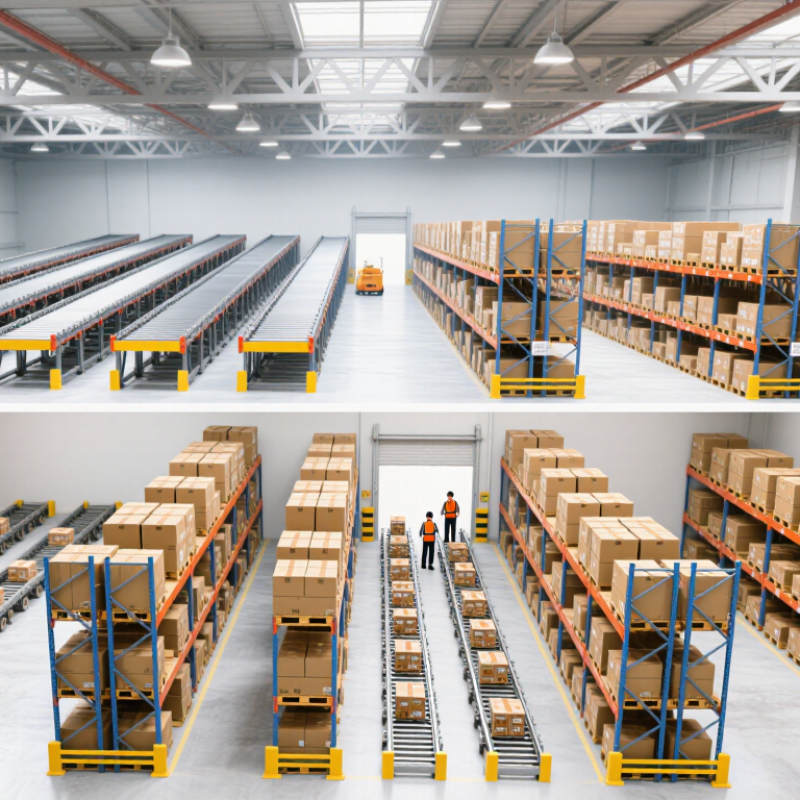
Top 10 Types of Carton Flow Storage for Warehouses

Define Carton Flow Storage and Its FIFO Principle in Warehouse Operations

Carton flow storage is a shelving system that moves cartons from the loading side toward the picking side. It usually uses rollers, wheels, or inclined lanes. Gravity does the quiet work. Workers load products from the rear and pick them from the front.

Its key rule is FIFO, meaning “first in, first out.” The carton placed earliest should reach the picker first. This method helps control stock age, especially for food, medicine, cosmetics, and other date-sensitive goods. It also reduces hidden inventory. A clear front picking face makes shortages easier to notice during routine checks.

Common carton flow designs include gravity roller lanes, skate-wheel lanes, adjustable lanes, divided lanes, high-density lanes, single-SKU lanes, mixed-SKU lanes, carton live storage, replenishment lanes, and order-picking modules. Each design changes how cartons move and how much space workers need. In practice, smooth cartons may travel too quickly, while rough cartons can stop midway. Lane slope, carton weight, and packaging quality must be tested before full installation.

FIFO is helpful, but it is not automatic. Poor loading habits can reverse the sequence. Damaged cartons can block a lane. Fast-moving products may also need more replenishment space than expected. Warehouse teams should inspect rollers, labels, and lane conditions regularly. A small trial with real cartons often reveals problems that drawings miss.

Classify 10 Carton Flow Rack Types by Load, Roller, and Shelf Design

Carton flow racks support fast picking, but their designs suit different loads and carton bases. MHI’s 2024 Annual Industry Report surveyed over 1,000 supply-chain professionals and identified robotics and automation as major investment priorities. That trend makes accurate rack selection more important.

The ten common types can be classified by load, roller, and shelf design.

Light-load gravity roller racks Light-load gravity roller racks suit small cartons and narrow lanes.
Medium-load gravity roller racks Medium-load gravity roller racks handle denser cases.
Heavy-duty roller racks Heavy-duty roller racks support bulky cartons and reinforced packaging.
Wheel-bed racks Wheel-bed racks use closely spaced wheels for smooth carton movement.
Skate-wheel racks Skate-wheel racks fit lightweight cartons with firm, flat bottoms.
Ball-bearing racks Ball-bearing racks reduce starting resistance for sensitive products.
Powered carton flow racks Powered carton flow racks use motorized rollers for higher picking volume.
Adjustable-shelf racks Adjustable-shelf racks allow changing carton heights.
Inclined-shelf racks Inclined-shelf racks improve front access through controlled gravity.
Multi-tier flow racks Multi-tier flow racks combine several shelf levels in one picking station.

Each type changes replenishment effort, lane capacity, and operator reach. No design fits every warehouse. I would still test real cartons.

Tips: Measure carton weight, base stiffness, and daily picks before choosing rollers. The U.S. Bureau of Labor Statistics reported 1.5 million warehouse and storage workers in 2023, so ergonomic access deserves attention. Keep pick faces between comfortable waist and shoulder zones. Check the first carton’s travel speed. It may stop too early. A short pilot with loaded shelves can expose unstable cartons, poor replenishment access, and misleading catalog ratings.

Match Carton Sizes to 3–5% Track Inclines and Gravity-Flow Requirements

Top 10 Types of Carton Flow Storage for Warehouses

Carton flow storage works best when carton dimensions match the track design. Gravity lanes commonly use a 3–5% incline to move cartons toward the picking face. A 3% slope may suit light, smooth-bottom cartons. Heavier cartons often need stronger momentum and careful stopping control.

Common systems include roller tracks, wheel tracks, gravity lanes, carton flow racks, divided shelving, and pallet-supported flow frames. Each type responds differently to carton width, weight, and base texture. Measure the smallest and largest carton before selecting the lane. A narrow carton can twist between rollers. A soft box may drag instead of flowing.

Tips: Test real cartons on a short sample track. Load the heaviest carton first, then the lightest one. Check whether cartons stop safely at the front. Record movement after several replenishment cycles. Small changes matter.

Warehouse trials often reveal problems that calculations miss. Dust, crushed corners, and uneven carton bottoms can reduce flow. I have seen a 5% incline move heavy cartons well but push light cartons too quickly. That creates impact damage. A 3% incline may feel safer, yet some cartons stop halfway. Not ideal. Adjustable lane guides, brake rollers, and clear loading limits can improve control. Review the setup after seasonal carton changes, because a storage lane designed last year may not fit today’s packaging.

Compare Throughput, Pick Rates, and Space Utilization Across the 10 Types

Carton flow storage is not one design. Ten common types include single-sided FIFO, double-sided FIFO, gravity roller, wheel-bed, skate-wheel, static carton-flow shelving, mobile carton flow, mezzanine carton flow, pick-module flow, and hybrid flow with pallet reserve. Single-sided FIFO supports clean stock rotation, while double-sided systems increase density. Gravity rollers usually improve replenishment speed. Wheel-bed lanes suit lighter cartons and short travel distances. Mobile and mezzanine designs save floor space, but they may slow access during congestion.

Throughput depends on carton weight, lane length, replenishment timing, and SKU velocity. In practical warehouse studies, well-designed flow lanes often support about 80–150 picks per labor hour, while poorly replenished lanes can fall below 60. WERC’s DC Measures reports show wide productivity variation across facilities, so one universal pick-rate target is unreliable. Pick modules can raise rates by placing fast movers near waist height. Hybrid flow reduces reserve travel, but it adds coordination work. That trade-off matters.

Space utilization also changes sharply. Double-sided and mobile layouts may approach 70–85% usable floor utilization, while single-sided layouts often provide easier access with lower density. These figures are planning ranges, not guarantees. MHI’s 2024 Annual Industry Report found that 55% of respondents were increasing technology investment, yet automation alone cannot fix poor slotting. I would test ten sample SKUs for two weeks before committing. Real sites rarely behave neatly. A short carton can jam a long lane, and that small failure can erase expected throughput gains.

Apply RMI MH16.1 Safety Criteria to Layout, Loading, and Inspection Controls

Carton flow storage can take many forms: single-deep lanes, double-deep lanes, pallet-supported flow, carton live racks, pick modules, mobile flow units, gravity roller lanes, wheel-bed lanes, FIFO lanes, and hybrid shelving. Each design changes load behavior, access, and inspection needs. RMI MH16.1 safety criteria should guide the layout, not appear as an afterthought.

Clear aisles protect both workers and equipment. Lane depth must match carton weight, size, and replenishment frequency. Heavy cartons belong in lower positions. Rollers and wheels need suitable spacing, end stops, and controlled carton speed. Uprights, beams, braces, and anchors require proper capacities and installation checks. Never assume an existing slab can support a revised rack arrangement. Confirm the design with a qualified engineer and the current standard edition.

Loading discipline matters. Place cartons squarely, prevent overhang, and remove damaged packaging quickly. Labels should show maximum lane loads and safe operating instructions. Scheduled inspections should examine bent frames, loose anchors, missing guards, worn rollers, and obstructed aisles. A simple checklist helps, but it can miss subtle deformation. That weakness deserves attention. Record findings, isolate unsafe sections, and repair them before reuse. Supervisors should train employees to report small changes, including unusual noise or uneven carton movement. Safety improves when the layout reflects real work, not only a clean drawing.

Top 10 Types of Carton Flow Storage for Warehouses

Each configuration is mapped against six practical safety-control domains: layout clearance, rated loading, rack condition, lane components, anchorage or stability, and inspection access. Use the comparison during design reviews and documented inspections aligned with RMI MH16.1 principles.

The values represent the number of applicable control domains for each storage configuration; they are planning indicators, not permitted load ratings or a substitute for the rack manufacturer’s specifications and a qualified safety review.

FAQS

What is carton flow storage?

Carton flow storage uses rollers, wheels, or inclined lanes to move cartons forward. Workers load from the rear and pick from the front. Gravity is quiet.

How does the FIFO principle work in a carton flow rack?

FIFO means “first in, first out.” The earliest loaded carton should reach the picker first. This helps manage product age and reduce hidden inventory.

Which products benefit most from FIFO storage?

Date-sensitive goods benefit greatly, including food, cosmetics, and other products with limited shelf life. Clear picking faces make aging stock easier to notice.

What types of carton flow racks are commonly used?

Common designs include gravity rollers, skate wheels, adjustable lanes, divided lanes, and high-density lanes. Other options include powered rollers, inclined shelves, and multi-tier stations.

How should a warehouse choose the right roller design?

Measure carton weight, base stiffness, packaging quality, and daily picking volume. Skate wheels suit lightweight cartons with firm, flat bottoms. Heavy cartons need stronger support.

Can carton flow storage move every carton smoothly?

No. Smooth cartons may move too quickly, while rough cartons can stop midway. Lane slope and carton weight require practical testing.

What problems can weaken FIFO performance?

Poor loading can reverse the intended sequence. Damaged cartons may block lanes, and fast-moving products may need more replenishment space. FIFO is not automatic.

How can workers improve safety and picking comfort?

Keep common pick faces between comfortable waist and shoulder levels. Check rollers, labels, lane conditions, and carton travel speed regularly. Small trials reveal overlooked problems.

Conclusion

Carton Flow Storage is a gravity-assisted warehouse solution designed to support efficient FIFO (first-in, first-out) operations. By placing cartons onto slightly inclined tracks, products move from the loading side toward the picking side, helping maintain stock rotation and reduce unnecessary handling. This article introduces ten types of carton flow racks, classified by load capacity, roller configuration, shelf structure, and track design. It also explains how carton dimensions, weight, surface condition, and packaging shape influence the selection of flow components and the recommended 3–5% track incline.

The comparison examines throughput, picking rates, accessibility, and space utilization across each rack type, helping warehouses choose an appropriate solution for different order profiles. In addition, the article highlights essential safety practices based on RMI MH16.1 criteria, including proper layout planning, rated loading, secure installation, collision protection, routine inspections, and employee training. Together, these guidelines support a safer, more organized, and more productive carton-picking environment.

Amelia

Amelia

Amelia is a seasoned marketing professional with a wealth of expertise in our company’s core offerings. With an unwavering passion for driving growth and innovation, she plays a pivotal role in shaping our marketing strategies and enhancing brand visibility. A key aspect of her responsibilities......